The Quick Answer: Yes, You Can Fly With Your Pet
Let's start with the good news. All six major US airlines allow pets in the cabin. If your pet is small enough to fit in a carrier under the seat in front of you, you can bring them along. The not-so-good news? If your pet is too big for the cabin, your options are way more limited than they used to be.
Several airlines have shut down their cargo pet programs in recent years. United killed PetSafe. Delta Cargo is now military-only. That means if you have a 70-pound Lab, you're basically looking at American Airlines cargo, Alaska Airlines cargo, or hiring a third-party pet shipper.
Here's the full comparison.
Side-by-Side Airline Pet Policy Comparison
| Airline | Cabin Fee | Cabin Carrier Size | Cargo Available? | Cargo Fee | Pets Allowed |
|---|---|---|---|---|---|
| Delta | $150 domestic, $200 international | 18" x 11" x 11" (soft-sided) | Military/State Dept only | Varies | Dogs, cats, household birds (domestic only) |
| United | $150 each way | 18" x 11" x 11" (soft) or 17.5" x 12" x 9" (hard) | No (PetSafe discontinued) | N/A | Dogs and cats only |
| American | $150 each way | 17" x 11" x 9.5" (soft) | Yes | $150+ (up to 150 lbs with kennel) | Dogs, cats |
| Southwest | $125 each way | 18.5" x 13.5" x 9.5" | No | N/A | Dogs, cats |
| Alaska | $100 each way | 17" x 11" x 9.5" | Yes | $200 each way (up to 150 lbs) | Dogs, cats, rabbits, birds |
| JetBlue | $125 each way | 17" x 12.5" x 8.5" | No | N/A | Dogs, cats |
Best deal for cabin travel: Alaska Airlines at $100 each way. They also allow the widest variety of pets (dogs, cats, rabbits, and birds). Best for large dogs: American Airlines and Alaska Airlines are the only two major carriers still offering cargo to the general public.
Cabin vs. Cargo: What's the Difference?
In-Cabin
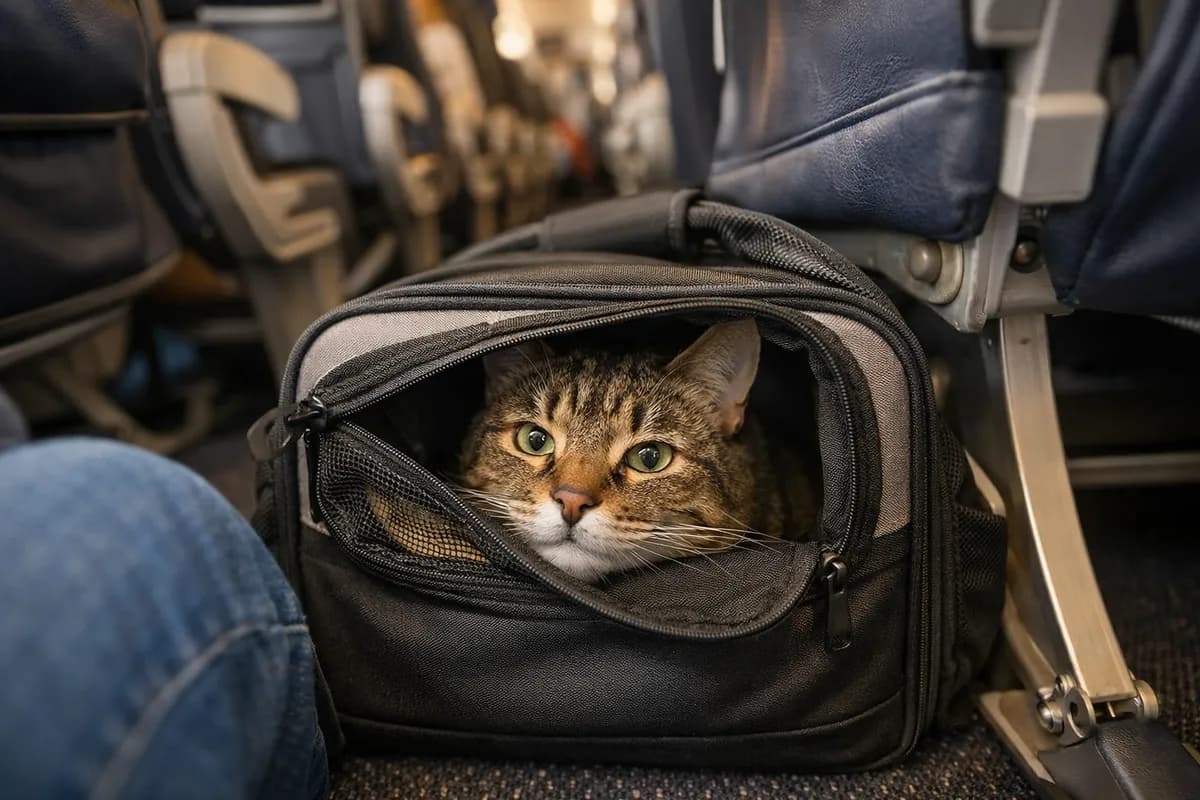
Your pet rides under the seat in front of you in an airline-approved carrier. They need to stay in the carrier for the entire flight (no, you can't take them out for a cuddle at cruising altitude). The carrier counts as your carry-on, so you'll need to check your bag or use a personal item.
In-cabin is limited to small pets. The general rule is that the pet and carrier together should weigh under 20 pounds, and the carrier needs to fit the airline's specific dimensions. Every airline's measurements are slightly different, so check the exact numbers in the table above before you buy a carrier.
Cargo Hold
The cargo hold is pressurized and temperature-controlled, not the freezing luggage area some people imagine. It's the same pressurized section as the cabin, just below the passenger deck. Pets travel in IATA-approved hard-sided kennels with food and water dishes attached.
Cargo is more expensive and involves more logistics, but it's the only option for medium and large dogs. The pet needs a health certificate (typically issued within 10 days of travel), and some airlines require specific crate sizes based on your pet's measurements.
Third-Party Pet Cargo
Since Delta and United dropped their public cargo programs, many pet owners now use third-party pet shipping companies that book cargo space on various airlines. These companies handle the crate, paperwork, airport drop-off, and pickup at the destination. It costs more ($500 to $2,000+ for domestic), but they deal with all the logistics.
Airline-by-Airline Deep Dive
Delta Air Lines
Delta charges $150 for domestic cabin travel and $200 for international routes. They accept dogs, cats, and household birds (birds on domestic flights only). The carrier must be soft-sided, 18" x 11" x 11" max, with ventilation on at least 3 sides (4 sides for international). Pets must be at least 8 weeks old for domestic and 6 months for international dogs entering the US.
The big limitation: Delta Cargo no longer accepts pets from the general public. It's restricted to active-duty military with PCS orders and US State Department personnel. If your dog is too big for the cabin on Delta, you'll need another airline or a pet shipping company.
United Airlines
United charges $150 each way. Only dogs and cats are allowed, cabin only. They accept both hard-sided (17.5" x 12" x 9" max) and soft-sided (18" x 11" x 11" max) carriers. Pets must be at least 2 months old for domestic flights, 4 months for international.
United discontinued their PetSafe cargo program, so there's no cargo option at all. The carrier counts as your carry-on bag, meaning you can't bring an additional carry-on. If you have a long layover, there's an extra $125 fee.
American Airlines
American charges $150 each way for cabin travel. They're one of the few major airlines that still offers cargo to the general public, with cargo pets up to 150 pounds (including kennel) starting at $150 one way. Soft carriers for cabin must fit within 17" x 11" x 9.5". Hard-sided cargo kennels can be up to 40" x 27" x 30".
If you have a medium or large dog, American is one of your best airline options right now.
Southwest Airlines
Southwest charges $125 each way. Dogs and cats only, cabin only, no cargo at all. The carrier can be up to 18.5" x 13.5" x 9.5", which is actually the most generous cabin carrier size of any major airline. Southwest doesn't have assigned seats, so you can pick a seat with more under-seat space when you board. No breed restrictions listed.
Alaska Airlines
Alaska has the lowest cabin fee at $100 each way (reduced to $100 for Hawaii routes starting January 2026). They accept the widest variety of pets: dogs, cats, rabbits, and household birds. Cabin carrier max is 17" x 11" x 9.5".
Alaska also offers cargo at $200 each way for pets up to 150 pounds. However, they do restrict brachycephalic (snub-nosed) breeds from flying. If you have a Bulldog, Pug, Boston Terrier, Pekingese, or Persian cat, Alaska won't let them fly.
JetBlue
JetBlue charges $125 each way for dogs and cats in the cabin. Carrier max is 17" x 12.5" x 8.5", which is on the smaller side. No cargo option. JetBlue flies primarily domestic and Caribbean routes, so it's a good option for short to medium domestic hops if your pet is small enough.
What Happened to Emotional Support Animals?
If you're wondering whether you can still fly your emotional support animal for free, the short answer is no. In 2021, the Department of Transportation changed the rules, and airlines jumped on it fast.
Here's how it works now:
- Service animals (dogs individually trained to perform tasks for a person with a disability) still fly free. This includes psychiatric service dogs trained for conditions like PTSD, anxiety, and depression.
- Emotional support animals are now treated as regular pets by every major US airline. That means carrier requirements, size limits, and the standard cabin pet fee all apply.
If you have a service animal, you'll need to submit a DOT form at least 48 hours before departure. The form requires you to attest that the dog is trained, vaccinated, and behaved. Airlines can also ask you to describe what task the dog performs.
Be careful with ESA letter services: There are companies online that sell "ESA letters" and claim they'll get your pet on a plane for free. This hasn't worked since 2021. If you buy one of these letters and show up at the airport expecting free pet travel, you'll either need to pay the cabin pet fee on the spot or leave your pet behind.
Breed Restrictions: Who Gets Turned Away
Brachycephalic (snub-nosed) breeds are the most commonly restricted pets on airlines. These breeds have shorter airways and are at higher risk of breathing problems during flight, especially in cargo where temperatures and pressure fluctuate more than in the cabin.
Commonly restricted breeds include:
- Dogs: Bulldogs (English, French, American), Pugs, Boston Terriers, Pekingese, Shih Tzus, Boxers, Cavalier King Charles Spaniels, Mastiffs, Lhasa Apsos
- Cats: Persians, Himalayans, Burmese, Exotic Shorthairs
Not every airline restricts all of these breeds, and some only restrict them from cargo (not cabin). Alaska Airlines is the strictest about brachycephalic restrictions. Southwest and JetBlue are more relaxed because they only offer cabin travel, where the risk is lower.
If you have a snub-nosed breed, your best option is often cabin travel (if they're small enough) or ground transport. Many pet shipping companies specialize in brachycephalic breeds and use climate-controlled ground vehicles to avoid the air travel risks entirely.
Tips for a Smooth Flight With Your Pet
- Book early and call ahead. Most airlines limit the number of pets per cabin per flight (usually 2 to 4). Book your pet's spot when you book your ticket, not the day before.
- Get the right carrier before your flight. Buy a carrier that fits your specific airline's dimensions. Measure it yourself because manufacturer specs don't always match reality. Let your pet spend time in the carrier at home for at least 2 weeks before the trip.
- Don't sedate your pet. Airlines won't accept sedated animals, and the American Veterinary Medical Association advises against it. Sedation can cause respiratory and heart problems at altitude, and it impairs your pet's ability to regulate body temperature. Use natural alternatives: ThunderShirts, pheromone sprays like Adaptil (dogs) or Feliway (cats), or calming supplements recommended by your vet.
- Exercise before the flight. A tired pet is a calm pet. Give your dog a long walk or your cat an extended play session before heading to the airport.
- Freeze water in the dish. For cargo travel, freeze water in the crate's attached dish. It won't spill during loading but will melt during the flight so your pet has water.
- Fly direct when possible. Every connection adds stress, handling time, and risk of delays. A nonstop flight is always better for your pet.
- Avoid peak travel days. Midweek flights tend to be less crowded and less chaotic, which means less stress for everyone, including your pet.
- Carry a health certificate. Even if your airline doesn't explicitly require one for domestic flights, having a recent health certificate (within 10 days) can prevent problems at the gate. Some airlines do check.