So, How Much Are We Talking?
If you've ever Googled "how much does it cost to ship a pet," you probably got a frustrating non-answer like "it depends." And yeah, it does depend. But you deserve actual numbers, so let's get into it.
Here's the quick version:
| Type of Move | Typical Range | What That Gets You |
|---|---|---|
| Short ground trip (under 300 miles) | $200 to $600 | Door-to-door van transport, one handler |
| Cross-country ground (1,000+ miles) | $1,000 to $3,500 | Multi-day drive, climate-controlled vehicle |
| Domestic flight (in-cabin) | $95 to $200 | Pet under your seat, airline-approved carrier |
| Domestic flight (cargo hold) | $300 to $1,000 | Pressurized, temp-controlled cargo compartment |
| International (standard) | $1,500 to $6,000 | Flights, paperwork, customs clearance |
| International (with quarantine) | $3,000 to $12,000+ | Australia, Japan, Hawaii, etc. |
Those ranges are wide because a 10-pound cat moving from New York to Boston is a completely different job than shipping a 90-pound German Shepherd from Texas to Tokyo. Let's break down what drives those numbers.
Ground Transport Costs
Ground transport is the go-to option for domestic moves, especially if your pet doesn't do well on planes or you're moving somewhere within driving distance. Most ground transporters charge between $0.50 and $2.00 per mile in 2026.
But here's the thing. Shorter trips often cost more per mile than longer ones. That's because drivers still have to factor in fuel, time, and the minimum effort to take the job. A 100-mile trip might run you $250 to $400, while a 2,000-mile cross-country haul might come out to $0.75 per mile because the distance makes it worth the driver's time.
Private vs. Shared Transport
You'll see two main options when you shop around:
- Private transport means your pet rides alone (or with your pets only) in a dedicated vehicle. It's faster and more personal, but it costs more. Expect $1.00 to $2.00+ per mile.
- Shared transport means your pet travels with other animals heading in the same direction. It's more affordable (often $0.50 to $1.00 per mile) but the trip takes longer because the driver makes multiple stops.
For a cross-country move from, say, Los Angeles to New York (roughly 2,800 miles), you're looking at roughly $1,400 to $3,500 for private transport or $800 to $2,000 for shared transport.
Heads up: Some ground transporters quote a flat rate rather than per-mile pricing. Always ask what's included. You want to know if fuel surcharges, overnight stops, or tolls are baked in or tacked on later.
Domestic Air Shipping Costs
Flying your pet is faster but comes with more rules and more fees. There are three ways to fly a pet domestically, and each one has a very different price tag.
In-Cabin (Small Pets Only)
If your pet and their carrier together weigh under 20 pounds and the carrier fits under the seat in front of you, most airlines will let them ride in the cabin with you. Fees range from $100 to $200 each way depending on the airline. As of 2026, Delta, United, and American each charge $150 per segment, Southwest and JetBlue charge $125 each way, and Alaska is the cheapest of the majors at $100.
This is by far the cheapest way to fly with a pet. The catch? Your pet has to be small enough, and most airlines cap it at one or two pets per cabin per flight.
Checked Baggage / Cargo Hold
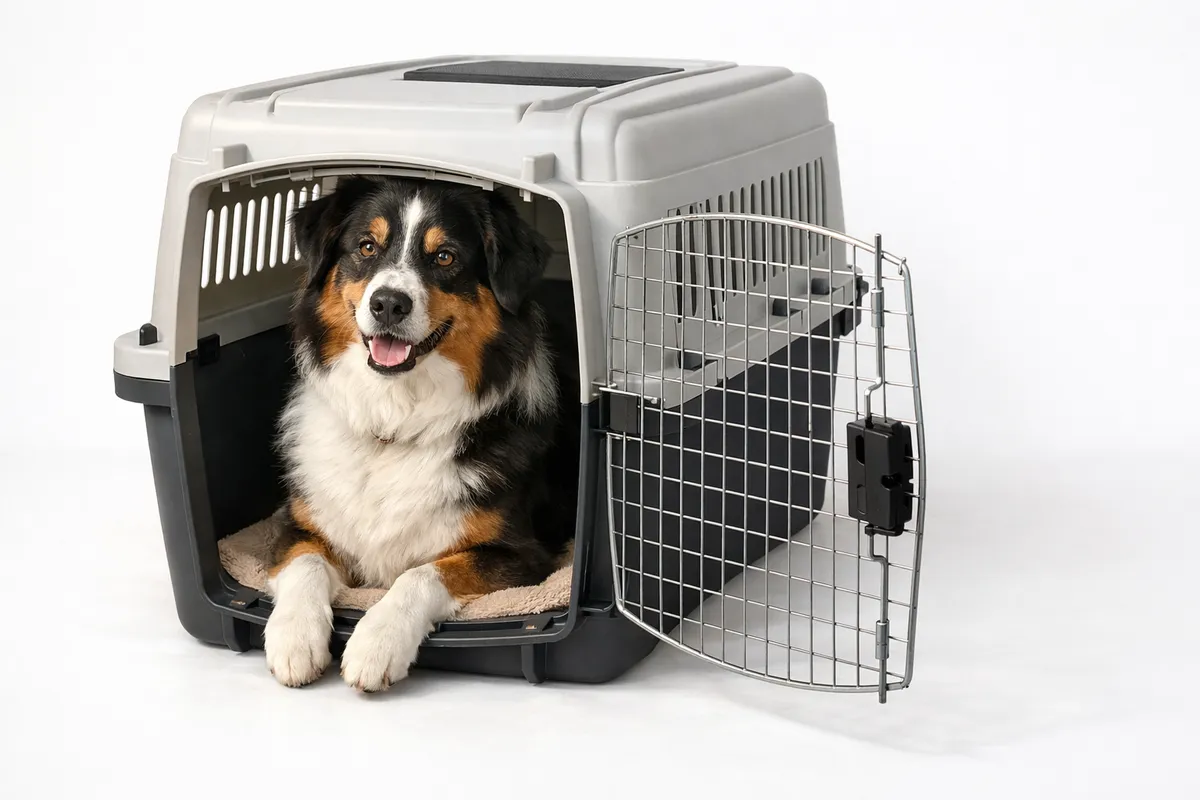
For pets too large to fit under a seat, they'll need to fly in the pressurized, temperature-controlled cargo hold. This runs $300 to $700 on average for a domestic flight. Larger crates cost more because airlines charge by volumetric weight (the size of the crate, not just the weight of your pet).
For a medium-sized dog like a Labrador, expect to pay around $400 to $600 for a domestic cargo flight. For a large breed like a Great Dane, that can climb to $800 to $1,000 once you factor in the oversized crate fee.
Pet-Specific Cargo Services
Some airlines and third-party companies offer dedicated pet cargo services where your pet flies as manifest cargo (not tied to your passenger ticket). This is common for breeders, rescues, and situations where the pet needs to fly unaccompanied. Expect $500 to $1,200 for domestic routes.
Important: Airlines impose seasonal embargoes when temperatures at origin, destination, or layover airports drop below 20°F or rise above 85°F. If your trip falls during a summer heat wave or winter cold snap, your options shrink and prices can jump $50 to $200 due to limited availability.
International Shipping Costs
This is where things get expensive. International pet shipping isn't just a plane ticket. It's a whole process involving veterinary prep, government paperwork, customs clearance, and sometimes quarantine. A typical international move for one dog runs $1,500 to $6,000, and complex routes can push past $10,000.
Here's a realistic breakdown for a medium-sized dog moving from the US to the UK:
| Cost Item | Estimated Range |
|---|---|
| Airline cargo fee | $800 to $2,500 |
| IATA-compliant crate | $100 to $400 |
| Vet exam + health certificate | $150 to $300 |
| USDA/APHIS endorsement | $101 to $206 |
| Rabies titer test (if required) | $100 to $275 |
| Microchip (if not already done) | $25 to $75 |
| Import permit (country-dependent) | $0 to $200 |
| Customs clearance at destination | $50 to $300 |
| Ground pickup/delivery at destination | $100 to $500 |
| Total estimate | $1,426 to $4,756 |
Destinations That Cost More
Some countries have stricter rules, which means more vet visits, more tests, and sometimes mandatory quarantine. Australia, New Zealand, Japan, Singapore, and Hawaii (yes, it's part of the US but has its own quarantine rules) are the most expensive destinations. Quarantine boarding alone can add $1,000 to $5,000 to your total.
Australia is notorious for being the priciest. Between the mandatory 10-day quarantine at the Mickleham facility, the rabies titer test that must be done at least 180 days before arrival, and the limited number of approved entry flights, most people end up spending $5,000 to $12,000 per pet.
New for 2026: The EU's updated pet travel rules took effect April 22, 2026. The key change for US owners: non-EU pets can no longer be issued an EU Pet Passport and now need a fresh EU Animal Health Certificate (AHC) for each trip, processed through the EU's TRACES system, with more consistent border verification across member states. Start your paperwork early.
What Actually Drives the Price Up (or Down)
Not all pet shipments are created equal. Here are the biggest factors that move the needle on cost:
Your Pet's Size and Weight
This is the single biggest cost factor for air travel. Airlines charge by volumetric weight, which means a 50-pound dog in a large crate costs significantly more than a 10-pound cat in a small carrier. A small dog or cat shipping domestically might cost $200 to $400, while a large breed on the same route could cost $600 to $1,000+.
Distance and Route
Obvious but worth noting: a 200-mile ground trip and a transatlantic flight are completely different price points. Direct routes are also cheaper than ones that require connections. A pet flying LAX to London Heathrow direct costs less than one that connects through a hub, because each leg adds handling fees.
Season and Timing
Shipping during January through March or September through November (off-peak months) can save you 20% to 30% compared to summer or holiday periods. Midweek travel can also knock off another 5% to 15%. If you have flexibility on dates, use it.
Service Level
A full-service door-to-door relocation company handles everything: vet appointments, paperwork, airport delivery, customs, and delivery at the other end. That convenience costs more than a DIY approach where you handle the prep and just pay for transport. Full-service international moves typically cost 30% to 50% more than partial-service options.
Special Needs
Brachycephalic breeds (pugs, bulldogs, Persian cats) often face extra restrictions and fees because they're at higher risk during air travel. Senior pets or those with medical conditions may need additional vet clearances or special handling, which adds cost.
How to Spend Less Without Cutting Corners
You don't want to cheap out when it comes to your pet's safety. But there are legitimate ways to bring the cost down:
- Get at least 3 to 5 quotes. Prices for the exact same route and service level can vary by 20% to 50% between companies. Don't just go with the first quote you get.
- Travel during off-peak months. January through March and September through November are your best bet. Avoid summer and the December holiday rush.
- Book early. Booking 4 to 6 weeks in advance can save you 10% to 20% compared to last-minute arrangements.
- Consider shared ground transport. If your pet is good with other animals and you're not in a rush, shared transport costs roughly half of what private transport does.
- Buy your own crate ahead of time. Shippers mark up crates. Buy an IATA-compliant crate yourself and you'll save $50 to $150.
- Ask about multi-pet discounts. Shipping two pets together is often cheaper per pet than shipping them separately. Some companies offer 10% to 25% off the second pet.
- Handle some paperwork yourself. If you're comfortable scheduling your own vet visits and submitting USDA paperwork, you can opt for a transport-only service instead of full-service relocation and save a few hundred dollars.
- Check if your employer covers it. Corporate relocation packages sometimes include pet shipping. Military families get reimbursement too ($550 for domestic PCS moves, up to $2,000 for overseas). Always ask.